

Article | Apr 16, 2021
The volume and value of coffee grows in Peruvian homes in the interior of the country
The increasing trend is in all regions of the country.
Coffee consumption in the urban areas of the Peruvian provinces is growing in volume and value. According to Kantar, in 2020, both indicators grew by 9% compared to 2018, a market that has not lost dynamics despite the pandemic.
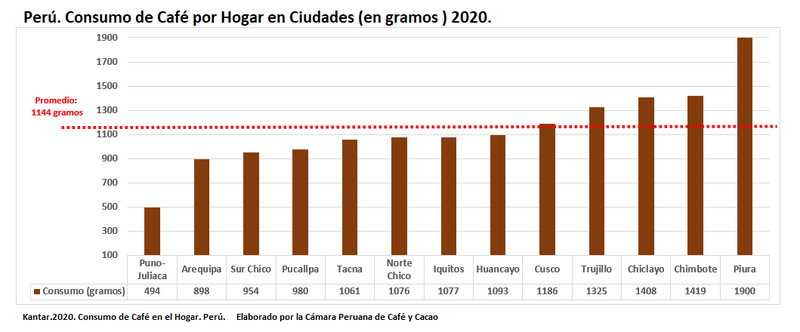
According to the study that the consultant carried out in the representative households of the cities in 13 cities of the country: the average consumption of coffee per household in these areas is 1,144 grams. Among the main cities that register the highest consumption per household are: Piura, Chimbote, Chiclayo, Trujillo and Cusco, whose consumption is above the average. We see that there are cities where it is consumed more, however, progress is reported in all.
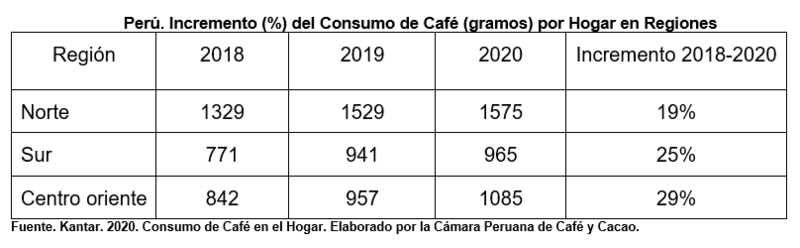
The higher consumption of coffee per household (grams) in the northern region may be influenced by the greater number of inhabitants in its urban areas, who have office routines typical of the coast that drive coffee consumption. However, the trend of increasing this consumption is common for all regions:
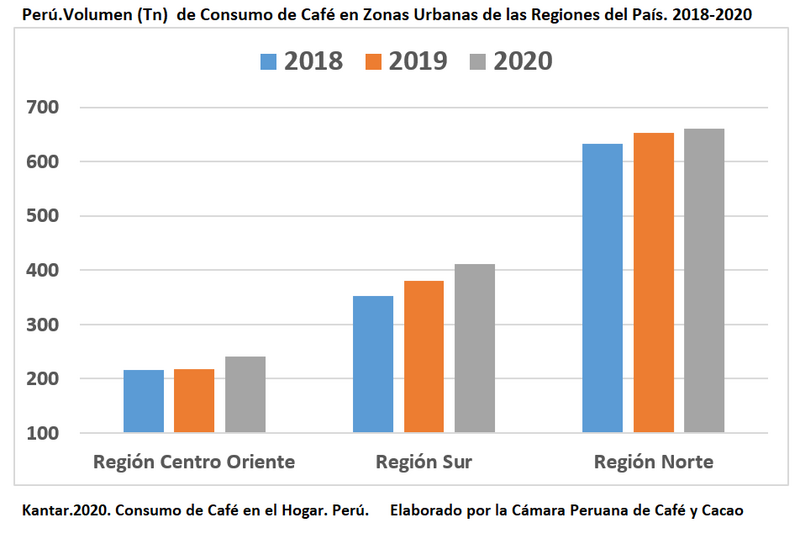
As a consequence of the above, in the 2018-20 period; the volume (Tn) of coffee consumption in urban areas of the country's regions increased. There has even been a greater willingness to pay for ground coffee, whose purchase receipt increased from 4 to 6 soles, while the receipt for soluble coffee remained at 2 soles. In 2020, this translated into an expense of more than S /. 148 million in coffee by families residing in the different cities of the regions of Peru.
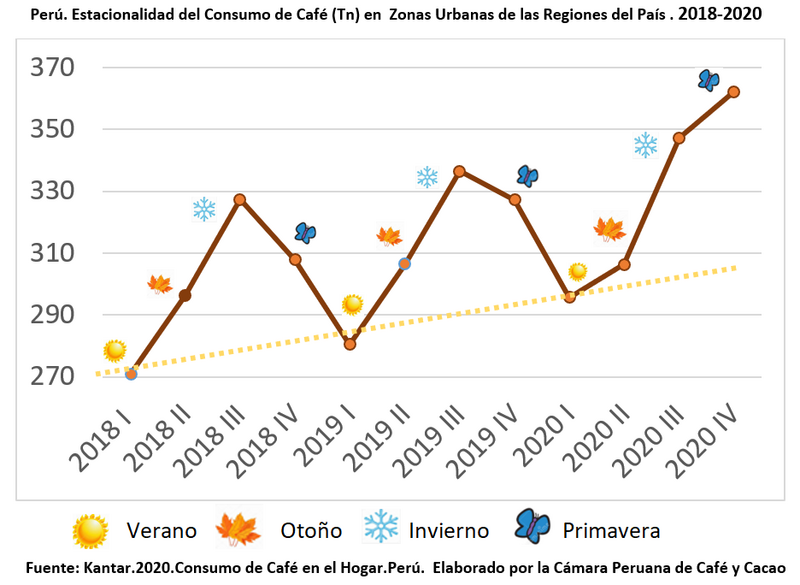
Another outstanding aspect corresponds to the variations in the seasonality of coffee consumption; As can be seen in the graph below, the volume of coffee consumed in the cities of the interior of the country seems to depend less and less on the climate, since it has been increasing in the summer, autumn and winter periods. Even the fall in the volume of consumption in the spring-summer transition is less and less significant. This evidence would indicate that the motivator for drinking coffee has gone from a functional dimension such as warming up in winter, to a more emotional dimension related to the new lifestyles that have emerged during the pandemic.
An important aspect that would be contributing that would be influencing this increase is the availability of coffee in these spaces, that associated with the new brands and coffee points of sale, an aspect that we will address in subsequent deliveries
The panorama in the last two years for the internal consumption of coffee in the cities of Peru; it is encouraging. In reality, the pandemic has boosted consumption in the regions, which together have shown a favorable behavior towards coffee in their new routines, integrating the product in their family basket, for longer periods of summer, autumn and winter.
Local coffee has brought consumers closer to producers in the COVID-19 period. The National Plan for the Promotion of Coffee Consumption will further promote this approach through the dissemination of key information on domestic consumption in representative cities of the Peruvian regions. This within the framework of the Alliance for Sustainable and Competitive Coffee Project, executed by the Peruvian Chamber of Coffee and Cocoa and the National Coffee Board as part of the SeCompetitive Program of the SECO Swiss Cooperation, in collaboration with Helvetas Peru and the Swiss Embassy in Peru.
____________________________________________________________________________________________________
INFORMATION SOURCES AND NOTES
- Kantar. 2020. Coffee Consumption in Homes in Cities Peru.
- Kantar 2020. Coffee Consumption in Households in Cities in the North, South and Center-East Regions. Peru.
- The northern region is made up of the cities: Piura, Chiclayo, Trujillo and Chimbote; The southern region is made up of the cities: Arequipa, Cusco, Tacna, Puno-Juliaca and Sur-Chico; the Central-Oriente region is made up of: Huancayo, Iquitos, Pucallpa and Norte Chico.
- The variable coffee consumption in grams per household in the Kantar database is quarterly; It was taken as a basis to calculate the annual consumption values ??per household in each Peruvian city that was part of the study; includes soluble coffee and ground coffee.
- The variable purchase ticket or expense per occasion in the Kantar database is quarterly; It was taken as the basis for calculating the annual purchase ticket.
- Expenditure on coffee consumption by families is an expression of the size of the market value (in millions of soles) for coffee consumption in households in the Peruvian cities that were part of the Kantar panel.
- For the analysis of seasonality, the following is considered: summer in the first quarter of the year, autumn in the second, winter in the third and spring in the fourth.