07 de May 2021 | Coffee
How is buying coffee in supermarkets changing?
Roasters weigh in on trends in the US market.
Excerpted from: Josef Mott. (April 21, 2021) “A drive for better quality”: How is supermarket coffee changing? - Perfect Daily Grind
Adapted by the Peruvian Chamber of Coffee and Cocoa
Every day millions of people around the world buy coffee in supermarkets; either instant, ground, in grains or in capsules. Despite this, among the specialty coffee consumer community there are negative preconceptions about supermarket coffee and its quality.
However, a growing demand of coffee consumers in search of quality, sustainability and production under ethical practices, in supermarkets; has driven change in this market segment. For this reason, today supermarkets offer a wider range of coffees.
To learn about supermarket coffee, how quality is changing, and why small roasters find it difficult to penetrate this mass market; Jhon Steel from Cafe Direct and Martin Mayorga from Mayorga Organics were interviewed.
Jhon Steel is the CEO of Cafe Direct; a roaster that sells coffee in the biggest supermarkets in the UK. Cafe Direct is also a company that invests 50% of all its profits in social programs to help coffee growers around the world.
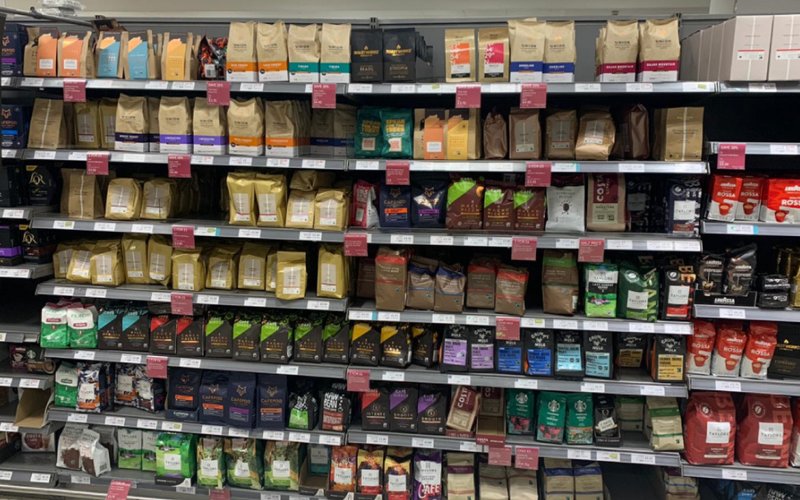
According to Jhon Steel, supermarkets that offer better quality premium products will naturally offer a wider range of high quality coffees. The consumer profile for each supermarket provides information on the quality attributes for the coffee they buy. Additionally, supermarkets include a variety of single origin coffees. Which helps the consumer to know where what they buy comes from.
While light roast coffee is popular with specialty consumers who prefer a unique and complex flavor; dark roast coffee is often consumed by "classic" coffee consumers, especially those who add milk and sugar to their beverage. This last group of traditional coffee consumers has a greater inclination to buy coffee in supermarkets, compared to specialty consumers, who most of the time buy directly from roasters.
Single origin, light roast coffees are starting to appear in supermarkets. In theory, this would have paved the way for small specialty coffee roasters to enter supermarkets. However, why aren't your products on the shelves?
A critical factor for selling in supermarkets is freshness. Shelf life is a fundamental aspect, because since the product usually goes through a long supply chain and remains next to competing products on a shelf for weeks, if not months; longer shelf life is desirable.
Fresh roasted coffee is not a common product in the larger supermarket chains. However, some have managed to shorten their supply chain, being more efficient in the sale of this type of coffee.
On the other hand, small roasters often build their brand around the "romance" or narrative behind the beans they sell. For this reason, in most cases, they demand a premium price. By not being flexible with their profit margin, supermarkets don't see their beans as a worthwhile investment. On the contrary, they perceive a scenario in which they try to enter a market that hardly compensates for the low profit margins, since the potential for sales volume is very small.
According to Martín: “The biggest mistake of the specialty coffee movements is that they think that the average consumer has the time and energy to think deeply about coffee the way they do. I believe that many perceive coffee as something they enjoy, and want to find it in accessible points of sale. They cannot perceive beyond this, as they have jobs and other responsibilities. So what we notice today is that small roasters are realizing that they can't just sell people what they like; but also what the market wants ”.
In supermarkets, as long as the brand of coffee is better, the quality is not necessarily better as well. However, there is a growing consumer inclination to appreciate the visual characteristics of the packaging, which qualifies the product as "unforgettable". Furthermore, sustainability is also a key factor in product marketing. Research from the New York University Leonard N. Stern School of Business in 2019 showed that sustainable products accounted for 50% of all packaged product consumption growth from 2013 to 2018.
The coffee segment in supermarkets is undoubtedly an intriguing market. It is not immune to the changes that affect the rest of the sector, but it is still difficult for small brands to break on their shelves and offer their products to more people.
While the quality of coffee in supermarkets has a long way to go, it is certainly increasing. There are more single origin coffees and better product mixes on the shelves than ever before, under either supermarket or private label brands.
Despite new trends, it is still important for brands in the coffee sector to maintain traditional flavors for mass market consumers. Supermarket customers are fundamentally different from specialty coffee consumers. Understanding this will be the key for any company wishing to enter this huge market.
____________________________________________________________________________
Josef Mott. (April 21, 2021) “A drive for better quality”: How is supermarket coffee changing?. Perfect Daily Grind
Adapted by the Peruvian Chamber of Coffee and Cocoa