16 de Dec 2021 | Coffee
Current political-economic situation affects purchasing power in the Peruvian agricultural sector
In the fourth quarter of this year, inflationary pressures would be the cause of a 22% drop in household income in the sector.
THE SITUATION
If 2020 was a year of severe economic impacts as a result of the pandemic, this year a very important recovery process began as economic activities resumed their dynamic losses. However, starting in the second half of this year, two events have threatened this recovery in almost all sectors, including agriculture.
On the one hand, the different antiliberal measures and positions of the executive - in addition to the corruption scandals linked to the 3 powers of the State - have ended up undermining expectations, numbing investments and discouraging capital mobility. On the other hand, the international context has also been playing a trick on us. The rise in price of one of the main commodities worldwide: 'oil and its derivatives' added to the problems of maritime commercialization already mentioned in a past article have ended up raising a series of imported products for direct consumption and also inputs for the agricultural sector.
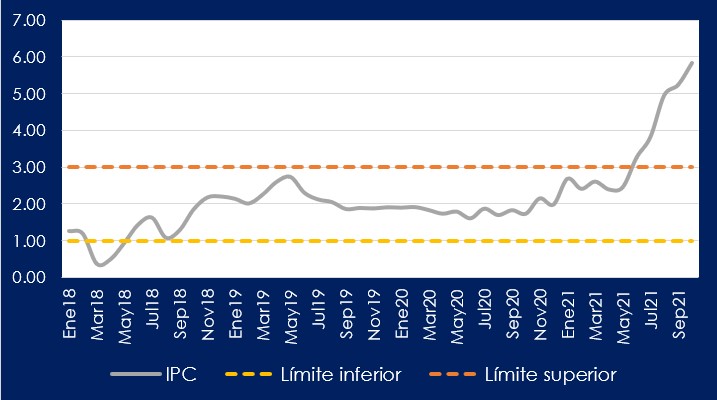
Graph 1. Inflation Target Range versus CPI (January 2018 - October 2021)
Source: BCRP, INEI. (2018-2021)
Note: CPI (consumer price index)
EFFECTS AND IMPLICATIONS
As a consequence of this context (both local and international), exchange rate pressures were immediate and ended up not only exceeding the explicit inflation targets of the Central Reserve Bank (see graph 1), but also refreshing long-forgotten periods of economic instability . The result is that the population has been gradually losing purchasing power, unbalancing family economies.
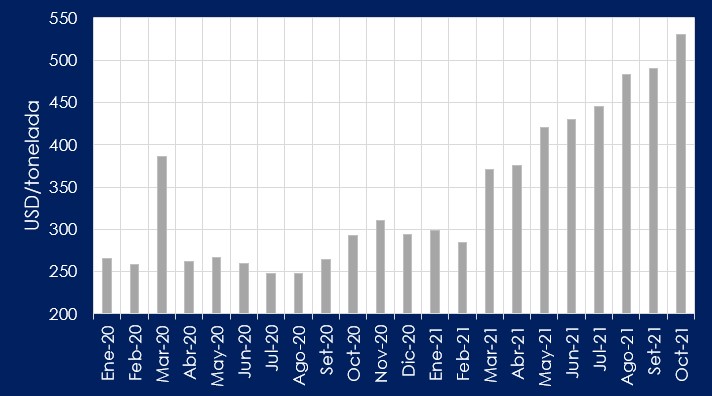
In urban areas, these losses may imply changes in the family basket, that is, budget adjustments between food, education, health goods, etc. In rural areas and, in particular, in peasant families, these losses in purchasing power can not only affect the composition of their family basket, but also their productive activities. The notable worldwide increase in the price of urea (see graph 2), in addition to other modern inputs for agriculture, have been raising production costs and making it difficult for agricultural production to function normally in the country.
Graph 2. CIF price of urea imports (USD / tons)
Source: Sunat - Customs Operations.
Note: CIF (Cost, Insurance and Freight)
In the case of coffee and cocoa producers, this panorama is not alien, since like the producers of other segments (or lines of crops) many of them do not dedicate themselves to a single crop (monoculture), but rather distribute their lands and resources in various agricultural and even livestock products, which allows them some diversification for the composition of their income.
In fact, according to the latest National Household Survey (Enaho, 2020), 79% of coffee producers and 72% of cocoa producers stated that they maintain at least one additional line of crops within their plots. Short-term economic shocks, therefore, continue to affect these producer segments as well.
IMPACT ASSESSMENT
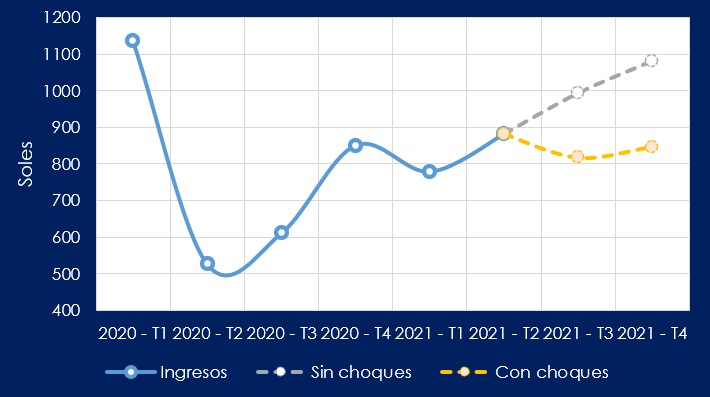
One way to quantify these impacts is precisely by observing the evolution of income in agricultural households. To do this, we have calculated the interannual variations in the Consumer Price Index and identified the losses in purchasing power given the short-term shocks the country is going through. Finally, we have transferred these losses to income and compared it with the trend evolution of income under a scenario without shocks (see graph 3).
Graph 3. Income of agricultural households and short-term shocks (soles). 2020-2021
Source: BCRP, Enaho 2020-2021.
As we can see, both the local and international circumstances will have a recessive impact on the country's family economy. In agricultural households, in particular, the loss of purchasing power is translating into a drop in income of 18% and 22% for the third and fourth quarters of this year, respectively. In monetary terms, this decline means a reduction of S /. 176 and S / 234 in the average income of these households.
If there were no short-term shocks, probably by the end of 2021, revenues would already be bordering on the levels reached before the spread of the pandemic in our country. However, inflationary pressures of both internal and external origin have been frustrating the economic recovery and, if these conditions continue, the recessive impacts on family economies could be prolonged.
Fact:
The Peruvian Chamber of Coffee and Cocoa, in coordination with the Swiss Cooperation and within the framework of the Alliance for Sustainable and Competitive Coffee Project, works on guidelines and promotion plans that include among their objectives to provide support to the productive and commercial activities of the Peruvian coffee growers. Therefore, we provide key information; valuable for the design of effective programs and projects to meet the needs of the agricultural sector.